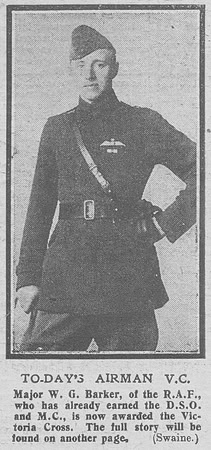
Barker W G Major VC DSO MC Royal Air Force The Graphic 2nd Dec 1918
William George "Billy" Barker, VC, DSO & Bar, MC & Two Bars (3 November 1894 – 12 March 1930) was a Canadian First World War fighter ace and Victoria Cross recipient. He is the most decorated serviceman in the history of Canada.
He was awarded the Victoria Cross for his actions on day 10, Sunday, 27 October 1918.
While returning his Snipe to an aircraft depot, he crossed enemy lines at 21,000 feet above the Forêt de Mormal. He attacked an enemy Rumpler two-seater which broke up, its crew escaping by parachute (the aircraft was of FAA 227, Observer Lt. Oskar Wattenburg killed). By his own admission, he was careless and was bounced by a formation of Fokker D.VIIs of Jagdgruppe 12, consisting of Jasta 24 and Jasta 44. In a descending battle against 15 or more enemy machines, Barker was wounded three times in the legs, then his left elbow was blown away, yet he managed to control his Snipe and shoot down or drive down three more enemy aircraft (two German pilot casualties were Vfw. Alfons Schymik of Jasta 24, killed, and Lt. Hinky of Jasta 44, wounded). The dogfight took place immediately above the lines of the Canadian Corps. Severely wounded and bleeding profusely, Barker force-landed inside Allied lines, his life being saved by the men of an RAF Kite Balloon Section who transported him to a field dressing station. The fuselage of his Snipe aircraft was recovered from the battlefield and is preserved at the Canadian War Museum, Ottawa, Ontario.
At a hospital in Rouen, France, Barker clung to life until mid-January 1919, and then was transported back to England. He was not fit enough to walk the necessary few paces for the VC investiture at Buckingham Palace until 1 March 1919.
Barker is officially credited with one captured, two (and seven shared) balloons destroyed, 33 (and two shared) aircraft destroyed, and five aircraft "out of control", the highest "destroyed" ratio for any RAF, RFC or RNAS pilot during the conflict. The Overseas Military Forces of Canada recognised Barker as "holding the record for fighting decorations" awarded in the First World War.
Source : Wikipedia